
The Rhino Report – August 2026

Posted on 11/08/2026 

by Matthew Thomas

Rhino Recruitment blog header banner

Welcome back to The Rhino Report.

Last month we looked at a recruitment market that was cooling without grinding to a halt. August's latest labour market figures suggest much the same picture. While some headlines paint a picture of a recruitment recession, the reality is far more complicated than a single vacancy figure can ever show.

In this month's report we're looking beyond the headline vacancy numbers to explore where demand remains strongest, why some of the biggest recruitment myths still refuse to disappear, how AI is changing recruitment without replacing it, and whether the traditional CV is slowly losing its place as the centrepiece of the hiring process.

The Recruitment Myths Everyone Still Believes

If you've spent five minutes on LinkedIn lately, you've seen someone declare that nobody's hiring, AI is taking every job, graduates are finished, and employers hold all the cards. Reality, as usual, sits somewhere in the middle.

Myth one: recruitment has stopped. It hasn't. There are still more than 700,000 vacancies across the UK, and plenty of employers are still hiring for the roles that matter most to their business.

Myth two: AI is replacing everyone. Not quite. AI-related skills now appear in a record 9.4% of UK job adverts, but the trend points to employers valuing people who can work alongside AI rather than cutting them out.

Myth three: employers hold all the cards. That depends entirely on the sector. General office roles attract huge applicant pools, but experienced engineers, construction professionals and skilled tradespeople remain in short supply across much of the country.

The biggest myth of all might be that the UK jobs market can be summed up in a single headline. It can't. Some sectors are slowing, others are growing, and understanding the difference matters far more than any one number.

Illustration of a magnifying glass examining newspaper headlines and a rising bar chart, representing scrutiny of recruitment market news

Looking Beyond the Headlines

At first glance, the latest vacancy figures appear fairly straightforward. Between April and June 2026, UK vacancies fell by 7,000 to 712,000. Plenty of headlines have focused on that decline, but the number becomes far more interesting when you place it into context.

Line chart showing UK vacancies falling by 7,000 to 712,000 between April and June 2026, according to ONS data

Figure 1: The estimated number of vacancies has seen a quarterly decrease of 7,000, to 712,000.

Vacancies have been gradually easing for some time. The exceptional hiring surge that followed the pandemic has largely settled, yet recruitment activity remains comfortably above the levels seen before 2020. Rather than signalling a market that's stopped hiring, the latest figures point towards one that's become more measured. Employers are still recruiting, although they're placing greater emphasis on business-critical roles instead of expanding teams wherever possible.

The balance between employers and candidates has remained relatively stable too. The ratio of unemployed people to vacancies has hovered around 2.5 for much of the past year, suggesting that while candidates may face slightly more competition for certain positions, employers also have access to a broader talent pool than they did during the height of the skills shortage.

Illustration of a magnifying glass examining a briefcase of files, representing closer analysis of vacancy figures

Where the Slowdown Is Really Happening

While overall vacancy numbers have edged down, the slowdown hasn't been spread evenly across the economy. Some industries are recruiting far less than they were a year ago, while others continue to create opportunities and compete for experienced people. Looking at the sectors behind the headlines tells a far more useful story than the national vacancy figure alone.

The latest ONS figures show vacancies fell across 10 of the UK's 18 industry sectors during the last quarter. Professional, scientific and technical services recorded one of the largest declines, alongside human health and social work, retail, hospitality and accommodation. Many employers in these sectors continue to balance rising employment costs with cautious consumer spending, making recruitment decisions more carefully than they did during the post-pandemic recovery.
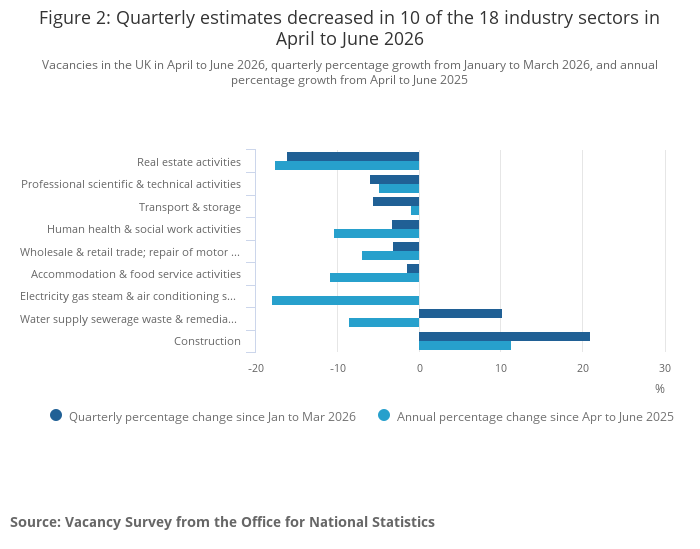
Bar chart showing quarterly vacancy estimates decreased in 10 of the 18 UK industry sectors between April and June 2026

Figure 2: Quarterly estimates decreased in 10 of the 18 industry sectors between April and June 2026.

Construction, however, continues to stand apart from much of the wider market. Ongoing infrastructure projects, housing developments and investment in energy are still driving demand for experienced site managers, quantity surveyors, engineers and skilled tradespeople. Manufacturing has also remained relatively resilient, with many employers continuing to recruit technical and production staff despite broader economic uncertainty.

This growing divide means candidates are having very different experiences depending on where they work. Someone applying for office-based or customer-facing roles is likely to face much stronger competition than they would have a couple of years ago. Meanwhile, experienced professionals in engineering, construction and other specialist industries often continue to receive multiple approaches from employers looking to fill difficult vacancies.

It's another reminder that there isn't one recruitment market. There are dozens of them, all moving at different speeds. Looking only at the national vacancy figure risks missing where genuine demand still exists, and for employers and candidates alike, understanding those differences has become far more valuable than following the headlines alone.

Illustration of a CV document burning away, symbolising the changing role of the traditional CV in hiring

Is the CV Slowly Dying?

For decades, the CV has been the starting point for almost every hiring decision. That's still true today, but the role it plays is beginning to change. Rather than acting as the deciding factor, it's increasingly becoming the first step in a much longer recruitment process.

Part of that change has come from AI. Candidates can now produce polished, well-written CVs in a matter of minutes, making it harder for employers to judge someone's ability from the document alone. While AI can certainly help improve presentation, recruiters are becoming much better at spotting generic or overly polished applications, and a CV that feels artificial can often do more harm than good.

As a result, many employers are placing greater emphasis on what comes after the application. Technical assessments, portfolios, practical tasks and competency-based interviews are becoming increasingly common, particularly for professional and specialist roles where experience is difficult to judge from a CV alone.

Indeed's latest labour market update found that AI-related skills now appear in a record 9.4% of UK job adverts, with demand spreading well beyond technology into marketing, finance, HR and management. Businesses aren't necessarily looking for AI experts, but they are increasingly interested in people who understand how to use new technology to work more effectively.

The CV isn't disappearing anytime soon. It remains one of the most important parts of the application process. What's changing is the amount of weight employers place on it. Increasingly, it's the introduction rather than the full story, with hiring managers expecting candidates to back up what's written on the page with practical skills, experience and evidence that they can deliver in the role.

Illustration of a downward arrow crushing a small shopfront, representing the impact of the slowdown on small businesses

Why Smaller Businesses Are Feeling It First

One of the more interesting findings in this month's labour market data has very little to do with industry. Instead, it highlights a growing difference between businesses of different sizes and the way they're approaching recruitment.

The largest quarterly fall in vacancies came from businesses employing between one and nine people. Larger organisations have reduced hiring too, but the biggest slowdown is coming from smaller employers, many of whom are facing rising employment costs while trying to protect already tight budgets.

Bar chart showing businesses with 1 to 9 employees contributed most to the quarterly decrease in vacancies, while businesses with 10 to 49 employees contributed most to the annual decrease

Figure 3: Businesses with one to nine employees contributed most to the quarterly decrease in vacancies, while businesses with 10 to 49 employees contributed most to the annual decrease.

For a small business, every recruitment decision carries significant financial weight. Once salaries, National Insurance, pensions and wider employment costs are factored in, taking on another member of staff becomes a major investment. Rather than rushing to recruit, many owner-managers are choosing to delay hiring, spread work across existing teams or bring in temporary support until they're more confident about future demand.

Larger employers are often in a stronger position to continue recruiting. Longer-term contracts, established workforce plans and bigger recruitment budgets give them greater flexibility, even if they're hiring more selectively than they were during the post-pandemic boom. Business-critical roles are still being filled, particularly where projects, customer demand or specialist skills leave little room to wait.

The result is a recruitment market that's becoming increasingly shaped by company size as well as sector. Two businesses operating in the same industry can have completely different hiring plans depending on their resources, workload and appetite for growth. For recruiters, employers and candidates alike, that's another reminder that the headline vacancy figure only tells part of the story.

Illustration of a question mark piercing a stack of job applications, representing candidates questioning why they haven't heard back

If You've Applied for 100 Jobs, Why Haven't You Had an Interview?

It's one of the biggest frustrations candidates are facing at the moment. People tell us they've applied for dozens, sometimes hundreds, of jobs without hearing anything back, while employers continue to say they're struggling to find the right people. At first glance those two statements seem to contradict each other, but they're both happening at the same time.

A big part of the answer comes down to where people are applying. Office support, administration and customer service roles can attract hundreds of applications within a matter of days, making it difficult for even strong candidates to stand out. Meanwhile, employers in construction, engineering, manufacturing and parts of healthcare continue to struggle to attract experienced professionals, despite receiving far fewer applications overall.

Recruitment has also become more targeted. With businesses recruiting more cautiously, employers are placing greater emphasis on finding someone whose experience closely matches the role from day one. The willingness to hire someone who could grow into the position is still there in some cases, but it's far less common than it was during the peak of the labour shortage.

Despite what many people assume, it's also rarely a computer making every decision. While technology helps employers manage large numbers of applications, most recruitment decisions still involve someone reviewing experience, qualifications and suitability before deciding who progresses to interview.

For candidates, the lesson is becoming increasingly clear. Sending another hundred identical applications is unlikely to improve the outcome. Taking the time to tailor a CV, target roles that genuinely match your experience and work with recruiters who understand your sector is far more likely to lead to interviews than relying on volume alone. In a market that's becoming more selective, quality is increasingly outweighing quantity.

Illustration of two groups of candidates divided by a widening crack, representing a growing divide in the job market

A New Divide Is Emerging

One of the clearest trends to emerge this year isn't simply that hiring has slowed. It's that employers are becoming far more selective about the skills they're looking for. While overall job postings have fallen, demand for certain capabilities continues to move in the opposite direction.

Indeed's latest labour market update shows UK job postings are down 11% since the beginning of the year, with graduate vacancies sitting at their lowest level for this point in the year since 2020. At the same time, demand for AI-related skills has reached a record high, now appearing in 9.4% of UK job adverts. What's particularly interesting is where that demand is coming from. It's no longer limited to software developers and data specialists. Marketing, finance, HR, operations and management roles are increasingly asking candidates to demonstrate at least a basic understanding of AI tools.

The result is a growing divide between candidates who can show they've adapted to new ways of working and those relying solely on traditional experience. Employers aren't necessarily looking for AI specialists in every department, but they are placing greater value on people who can improve productivity, solve problems and make better use of technology in their day-to-day work.

That shift is also influencing how recruitment takes place. Hiring decisions are taking longer, interview processes are becoming more thorough and employers are asking more questions before making an offer. Receiving more applications hasn't necessarily made recruitment easier. In many cases it's had the opposite effect, leaving hiring managers with larger shortlists to review while they continue searching for the handful of candidates who genuinely meet the requirements.

As the market becomes more selective, the difference between simply meeting the minimum requirements and offering something extra is becoming increasingly important. For both employers and candidates, the strongest outcomes are likely to come from understanding where demand is changing rather than assuming every part of the market is moving in the same direction.

Illustration of a magnifying glass reviewing a CV with an approval checkmark, representing employers assessing candidate skills

Recruitment Round-up

A few developments from the past month are worth keeping an eye on.

Indeed's latest labour market update shows UK job postings have fallen by 11% since the start of the year, with graduate vacancies at their lowest level for this point in the year since 2020. Summer is often a quieter period for recruitment, but this year's slowdown has been more noticeable as many employers continue to take a cautious approach to hiring.

At the same time, demand for AI skills continues to move in the opposite direction. A record 9.4% of UK job adverts now mention AI, reflecting how quickly employers expect technology to become part of everyday working life. It's no longer something limited to software development either, with marketing, finance, HR and management roles increasingly asking for candidates who are comfortable using AI tools.

Another trend emerging across the market is the widening gap between general recruitment and specialist hiring. While graduate recruitment remains under pressure and office-based roles often attract large numbers of applicants, employers continue to compete for experienced professionals in engineering, construction, manufacturing and other technical sectors where skills remain difficult to source.

Taken together, these developments point towards a recruitment market that's becoming more selective rather than significantly weaker. Opportunities are still there, but both employers and candidates are having to work harder to find the right fit. Understanding where demand remains strongest is becoming far more valuable than focusing on the headline vacancy number alone.

That's it for this month's Rhino Report. Thanks for reading, and we'll be back next month with another look at what's happening across the recruitment market.

Cookies on this website
We use cookies to provide the best experience on our website. You can accept all cookies or reject non-essential cookies. You can also change your preferences at any time. Please see our Cookie Policy for more information.